

July 2, 2026
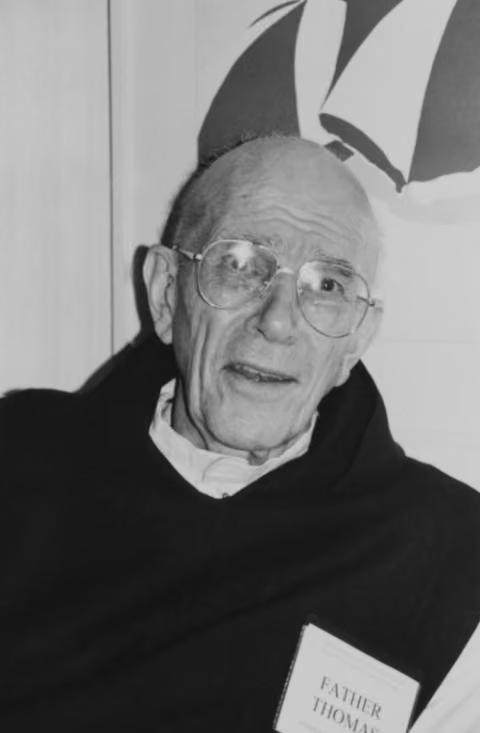
Thomas Keating was born in New York City in 1923 and died in 2018 at age 95 at St. Joseph’s Abbey in Spencer, Massachusetts. He went to Deerfield Academy, in
Massachusetts, Yale University for two years and graduated from Fordham University. He entered the Trappist Monastery in 1944 and became a priest in 1949. He was the abbot at St. Benedict’s in Snowmass, Colorado for 20 years as well as the abbot at St. Joseph’s Abbey in Spencer, Mass through the 1960’s and 1970’s. He wrote over 30 books and instituted Contemporary Outreach that still has groups all over the world that practice Centering Prayer today. Fr. Keating was tall and thin and radiated a sense of peace and lightness. He was often chuckling, lots of times at himself. He took God so seriously that he didn’t need to take himself seriously at all.
He retired at Spencer in the 1970’s to donate more time to deeper prayer and study. His goal was to share God with the world. He felt the gift of God is so intimate, there are no words to describe it. In one of his books, Intimacy with God, Keating says that thousands of Americans were going to India every year in search of Eastern Spiritual Masters to teach them spirituality primarily because they felt that the usual forms of prayer, like rote prayers, reading the Bible or even types of meditation were no longer working for them. The Eastern methods are primarily concerned with awareness where the usual flow of thoughts are disregarded for a certain period of time.
Drawing from The Cloud of Unknowing, the desert fathers and mothers, and other Christian mystical writers like John of the Cross and Theresa of Avila, Keating and two other Trappist monks—William Meninger and Basil Pennington—developed a simple method of silent prayer. This method came to be known as Centering Prayer, referencing Thomas Merton’s definition of contemplation as prayer “centered entirely on the presence of God”. So Fr. Keating decided to run workshops for many of these spiritual seekers in order to integrate the Eastern techniques into Christian faith experiences.
Centering prayer is a contemporary form of prayer of the heart at deepening levels that prepares us to receive the gift of Contemplative prayer. It is both a relationship with God and a discipline to get there. We consent to God’s presence and love within us.
God is already with us and in us. So Centering Prayer is simply sitting in silence as we gaze into the loving heart of God, and he gazes back in us with love. This prayer is beyond thoughts, emotions, or sensations, like being with a very close friend or lover, where words are not required. It’s a whole-hearted surrender to the present moment. As Thomas Keating says, “Silence is God’s first language. Everything else is a poor translation.”
God speaks to us in the silence of the heart, and we listen. And then we speak to God from the fullness of our heart in silence, and God listens. And this listening and this speaking is what prayer is meant to be—friendship with God.
Centering prayer may be accompanied by emotions and sentiments of love but does not require them because Divine love is not a feeling. Tears may even come and one doesn’t know why. And sometimes, we may enter what Theresa of Avila called the prayer of quiet where we feel enveloped in the arms of God, but that’s not necessary either. In fact, many initial enthusiasts lose interest when they get the message that Centering prayer is not a shortcut to bliss.
We enter our inner room, get comfortable and close our eyes. We take deep breaths and say a prayer to the Holy Spirit expressing your love and consent in spending this time with the Divine Presence. (I repeat the phrase, “Be still and know that I am God.”)
Because our minds are so attached to thinking, Father Keating suggests choosing a sacred word, (like Jesus, Lord, Yahweh, etc.) that has meaning for you, as the symbol of your intention to consent to God’s presence and action within. Sometimes, noticing my breath is more suitable for me. Every breath we take is the breath of God. As Richard Rohr says,”God is as available as breath itself”. Repeat the word a few times and let it draw us into interior silence. Remember the sacred word is not a mantra. Let go of all expectations or goals during this time. It is not about achieving anything, whether emptying our mind or finding peace, or achieving a spiritual experience.
The time of Centering prayer is the time to let go of all thoughts, whether the thoughts are pleasant or painful or whether they bring spiritual consolation or a bombardment of emotions. There is no way to succeed at Centering prayer, except to return again and again to God’s loving presence. As Thomas Keating says, “We have to keep showing up and let God do the rest.” That is why it can be difficult for some of us to feel at ease with this practice at first. We usually think that we have to do something to please God. It’s hard for us to give up control and surrender to Divine Presence.
When we quiet ourselves, many thoughts will grab our attention. (Ex. Forgetting to take out the meat in the freezer, a forgotten bill, spiritual things, even the solution to world peace.) Sometimes the same thought or feeling will circle by again and again, saying, “Think me”, “Feel me,” as it tries harder to be noticed. Just keep letting it go. The Buddhists call these distractions, the “monkey mind.” I call it “spiritual ADHD.” Extraneous thoughts are a normal part of Centering prayer. Psychologists have said that 93% of what we think about is mindless clutter. We do not judge our prayer by how many thoughts bombard us. Be gentle on yourself. When we become aware of thoughts, we return ever-so-gently to our sacred word, the symbol of our intention, and continue resting in God’s presence.
Remember God looks at our intention not our attention. Every time we move from a thought into the place of interior silence, we are renewing our love for God. (Ex. My spiritual director was a very good friend of Thomas Keating. In fact, she was the coordinator of Centering Prayer in the New England area. At her introductory Centering Prayer retreat with Father Keating, she told him that she felt like a failure because she had experienced at least 10,000 distractions during the 20 minute “sitting”. He exclaimed, “How lovely, in 20 minutes you‘ve had 10,000 opportunities to return to God!”)
At the end of the prayer period or sitting, we remain in silence with eyes closed for a minute or two. We say a prayer slowly. (I usually end with the Lord’s Prayer.) It is a beginning of letting our Centering prayer time with God flow out into the rest of our lives.
Suggested 2 sessions of 20 minutes a day, but if too much for you, begin with 5 to 10 minutes.
I just discussed Centering prayer 101. Now I want to discuss Thomas Keating’s interesting theory on the human condition (the title of one of his books), and how
God (the Divine Therapist) can heal the human condition through Centering Prayer.
As it says in Genesis, God made us in his image and likeness. Thus, God has wired us for love beginning with the gaze between a mother and her newborn that some experts say creates the mirror neurons necessary for a loving relationship.
Thomas Keating also states that each of us has three essential biological needs:
1. Security / survival
2. Power / control
3. Affection / esteem
Children who are deprived of security, affection and control needs develop a desperate drive to find more and more symbols of these basic human needs in their culture. This is called compensation and is based on one question, “Is it good for me”, thus the beginning of the false self. In the first years of life, this is normal. As adults, such motivation is childish. If we don’t face the consequences of this unconscious motivation (the Human Condition) through a practice or discipline that opens us to the unconscious—then the false self will influence our decisions all through our lives. Thus, the importance of a contemplative form of prayer such as Centering prayer.
Through Centering prayer we begin to realize that all these programs for happiness, based on the instinctual needs of security, power/control and affection/esteem are absolutely impossible to achieve or satisfy. When we have practiced Centering prayer for a while, we fairly quickly enter into an inner room of relative calm and quiet. This inner room is the office of the Divine Therapist. Our bodies begin to rest, a rest that is deeper than sleep. Rest in Centering prayer provides profound healing. We experience alternating consolation and desolation, reassurance and confrontation. We allow our dark side to come to full consciousness and then to let it go and give it to God. We discover the truth about ourselves that gradually heals the wounds of a lifetime. This self-knowledge is not crushing or discouraging but rather illuminating and encouraging because God helps us change our attitudes toward them. (Divine Therapy) As Theresa of Calcutta said, “Even though God loves us as we are, he loves us too much to leave us as we are.”
Many times there may be periods of dryness. (Dark Night) And sometimes, tears will come, and we don’t even know why. Deep meditation releases things in the unconscious that might take years to unload in therapy. God, the divine healer, heals us in ways that we don’t even know. And to be honest—Jesus talked a lot more about praying and healing than any of the issues that continue to preoccupy most of our churches.
The spiritual sense of rest that we experience in the beginning moves toward an abiding state that might be called “Peace.” It is beyond joy and beyond sorrow because it is rooted in the divine presence. We are not peaceful about something. We are just peaceful.
As I said before, we gaze into the loving heart of God, and he gazes back in us with love, just as that mother lovingly gazes at her newborn. So because we feel God’s love, we can more easily give that love to others and even learn to love ourselves that is sometimes the hardest part.
In conclusion, the fruits of Centering prayer has to flow into our daily life because as Jesus says, ”One can judge a tree by its fruits”. Otherwise, any prayer especially if it is consoling or peaceful, can degenerate into a high-class tranquilizer, leaving us in the same situation as before. In Centering prayer we come to experience not only our oneness with God in Christ, but also our oneness with all the rest of the Body of Christ. It teaches us how to love each other with the unconditional love that Christ loves us.
This contemplative journey is not a magic carpet to bliss as I said before. It is a method of letting go of the false self, a humbling process, because it is he only self we know. Then we are in a space that is both empty of the false self and full of God which is who we really are. (True self)
Centering prayer is a process so God can continue to develop within us ever deeper levels of intimacy that are absolutely inconceivable to us in the beginning. It is every human relationship that is beautiful and good and true all rolled into one and multiplied millions of times over. We become sensitized to the presence of God in everyone, in fact to all of creation. Without thinking about it, we become the mind of Christ. (Divine Union.)
According to Thomas Keating, this Divine Therapy through Centering prayer is an extraordinary project that only God could have thought up, and only God can persuade us to do it. Obviously, this process will not happen to everyone. But we are offered the opportunity. The priority we give to the invitation is up to us.


Rolling Ridge Retreat and Conference Center
660 Great Pond Road
North Andover, MA, 01845
thestaff@rollingridge.org
Phone: (978) 682-8815
Fax: (978) 681-1162
.avif)